
How we work
Producing an analysis, and saying where it stops
We process data — public data, yours, sometimes data nobody has gathered yet — to draw from it results a third party can reproduce. What follows describes our method, not a piece of software.
What we know how to do
Four moves, always the same
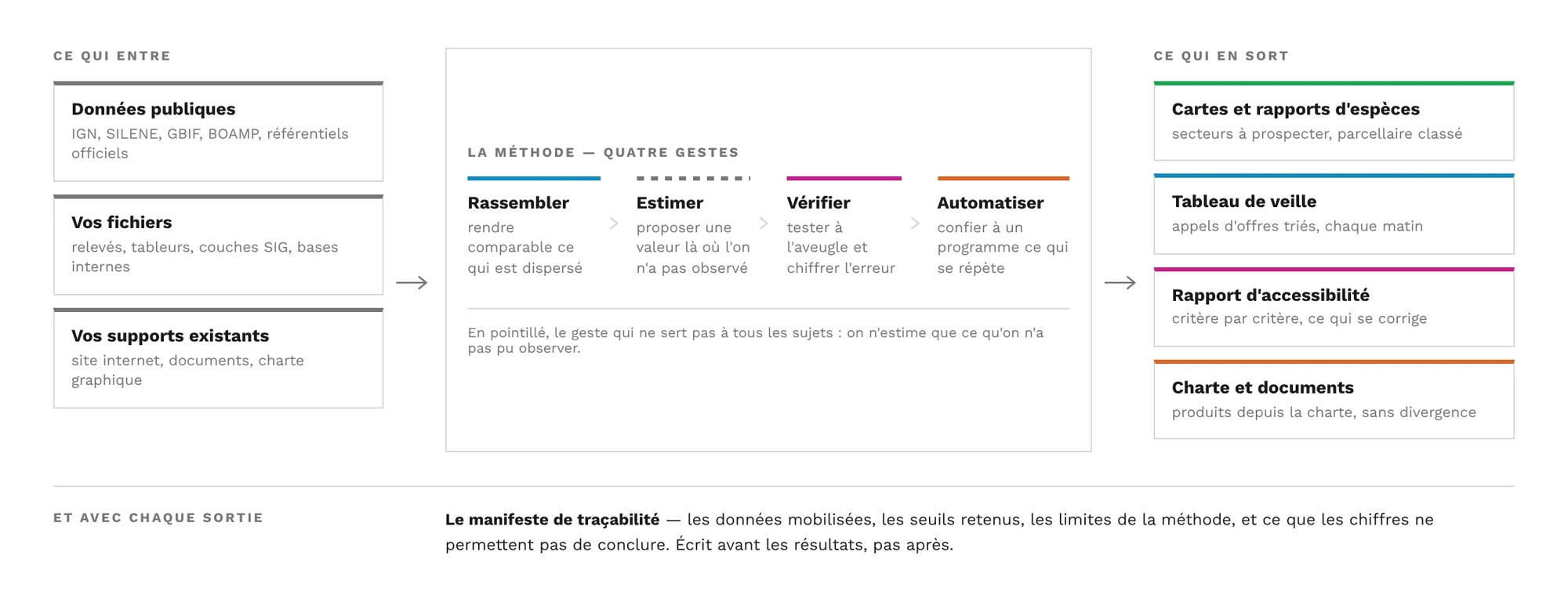
Text, figures or images: the move is the same — set aside what carries no information, and bring out what does. A territory, a website or a stream of tender notices break down in the same way.
Gathering what is scattered
Public databases, your own files, formats that do not speak to one another, and labels that do not mean the same thing from one source to the next. Making all of it comparable is often the longest part of the work, and it is where the errors nobody notices afterwards take up residence.
Estimating what has not been observed
A model does not read the future. It learns from what has already been observed and offers an estimate where nobody has been to look. That is useful precisely because one cannot go everywhere — and it is worth something only if one knows by how much one is wrong.
Checking, and quantifying the error
A result whose error cannot be stated is not a result. We test our models blind, on data they have not seen, and we publish the score — good or bad. A test chosen after the fact proves nothing.
Automating what repeats
An identified task, redone by hand every week, can be handed to a program: it leaves your working day altogether instead of merely getting shorter. The documents you receive from us — quotations, reports, brochures — are themselves produced this way.
How it unfolds
Writing the method before knowing the result
It is the one rule that holds up all the rest. A method described after the fact adjusts itself, without anyone meaning it to, to what was found.
- We set the scopeWhat is being looked for, over which area or which set, with which data, and what will not be concludable. Written down, and agreed with you, before anything is computed.
- We gather and we checkThe data are checked one by one, and what is missing is stated. A missing value is not a zero: confusing the two distorts everything that follows.
- We compute, and we measure the errorSeveral methods rather than one, to see whether they agree. When they diverge, we say so instead of picking one.
- We deliver with the manifestEvery deliverable comes with the data used, the thresholds adopted, the limitations of the method and what the figures do not allow you to conclude. That is what makes a result defensible before a third party.
Your data
They do not go anywhere else
The computations run in our own environment, hosted in Europe. Your files are processed there for your study, and deleted at your request. They are not fed to any public artificial-intelligence service and are used to train nothing other than the model for your own study.
We write the code of our own tools, which means two concrete things: we are not waiting for a vendor to get around to fixing something, and when a public server starts answering differently, we adapt the same day.
The limitations, stated by us
What we do not do
A tool that admits to no limitations has not been looked at closely enough. Here are ours, and we state them before anyone can hold them against us.
- We do not predict, we estimateA model says where something is probable, not where it is. The difference is not a turn of phrase: it changes what you are entitled to conclude from it.
- We replace neither fieldwork nor expertiseIn ecology, the survey remains mandatory and remains the document of record. Elsewhere it is the same: computation steers the work, it does not do it for you.
- Finer is not always betterOne can compute at five metres instead of twenty-five: the relief genuinely sharpens, the vegetation map does not, because its minimum mapping unit stays at twenty-five hectares whatever resolution is asked for. The pixel shrinks, the information does not — and we say so before the quotation.
- We do not deliver a result whose error we cannot stateIf there is no honest way of validating a computation, we say so and we do not sell it. It has happened, and it will happen again.
Where this method has been used
Four subjects with nothing in common
Territories and species
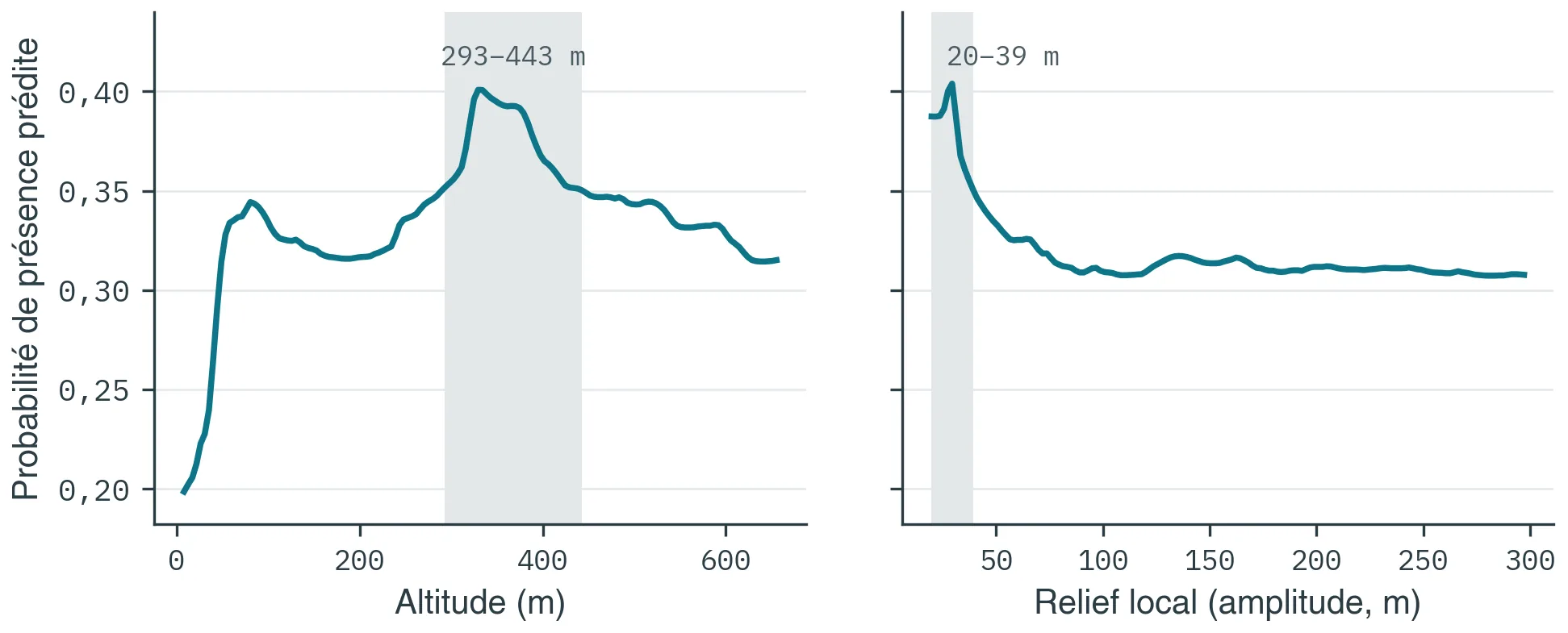
Estimating where protected species are most likely to be present, ahead of the survey, and combining species with one another. This is TerrArgos, our engine, set out in detail on the Solution page.
A stream of tender notices
Reading the official platforms every day, keeping only what matches your trades and your areas, and returning it as a clean table. Monitoring stops being a Monday-morning chore.
A website
Checking that it meets its accessibility obligations, criterion by criterion, and saying what can be fixed in the code and what calls for an editorial decision.
A brand identity
Testing a visual identity against its own rules across every existing medium, then producing the documents directly from it, so that they can no longer drift away from it.
And your subject
If you have data and a question
The most useful thing, at the first exchange, is to tell us what you are trying to decide — not what you expect from a tool. We will tell you what we can do, what we cannot, and what is not worth computing.